Product Update
Is Dock&Bay Still in Business? (2026 Update)
Is Dock&Bay from Dragons’ Den still around in 2026? The deal it made, the dragons who invested, and where to buy Dock&Bay today.

Where to buy Dock&Bay
Check the current price and availability on Amazon.
Affiliate link — we may earn a commission at no extra cost to you.
Dock&Bay is one of the clearer Dragons' Den success stories on record. The quick-dry, sand-free beach and travel towel brand pitched in series 15 and has spent the years since turning into a genuine multi-market business, not just a nice line on a founder's CV.
The short answer
Dock&Bay is still trading, and by most public signals it is thriving. The company runs its own website, sells across the UK and internationally, and by 2025 was marking a decade in business with a team that has grown to more than 30 people. It does not currently sell through Amazon, so the direct site is the main way to buy.
A ten-year anniversary for a company that started as a beach towel idea pitched to five investors is not a small thing. Most consumer product businesses that appear on the show do not make it that far.
The towel and travel accessories category is also more competitive now than it was when the founders first pitched, with dozens of copycat microfibre towels now sold cheaply through marketplaces. Surviving a decade in a category that has been actively commoditised by imitators says something about the brand's product quality and customer loyalty holding up under real pressure.
The Dragons' Den pitch
Andy Ellis and Ben Muller, the founders, brought Dock&Bay into the Den in series 15, episode 4, pitching microfibre towels built to be light, sand-resistant and quick-drying for the beach and travel market, a category dominated by heavy, slow-drying cotton towels that had not changed much in decades.
They asked for £75,000 in exchange for 10 percent equity, a valuation that signalled real confidence in the brand's growth potential rather than a modest lifestyle-business ask.
Pitching a better version of a mundane, unglamorous product, the beach towel, is a classic Dragons' Den play. The category was not exciting on paper, but the founders had clearly done the work of identifying a genuine, unmet functional gap, sand sticking to wet cotton towels, that every beachgoer has experienced but few businesses had bothered to fix properly.
The deal that got done
Deborah Meaden backed the pair for the full £75,000 at the 10 percent stake requested. Meaden has built her Dragons' Den reputation on consumer and retail brands with strong unit economics, and a travel towel with a clear point of difference and repeat-purchase potential fits that pattern well.
Landing Meaden as an investor also meant landing someone who has shepherded plenty of physical product businesses through the unglamorous grind of manufacturing, wholesale relationships and cash flow management, which is usually the part that kills consumer brands, not the initial idea.
Ten years and still growing
Dock&Bay has built out well beyond its original beach towel line, expanding into a broader travel and lifestyle range while keeping the microfibre, quick-dry positioning that got it noticed in the first place. The brand has been covered by mainstream outlets as a go-to recommendation for beach and travel gear years after its television debut, which is a good proxy for staying relevant rather than just staying open.
A team that has grown past 30 people is a meaningful scale-up from a two-founder pitch. It suggests the company built out proper operations, from supply chain to customer service to marketing, rather than running lean indefinitely on the strength of the original idea.
The brand has also leaned into sustainability messaging around its microfibre products, positioning itself against single-use and fast-fashion textile habits, which has helped it stand out in press coverage well beyond the original Dragons' Den appearance and kept it relevant to a newer, environmentally minded customer base.
A decade in business also means Dock&Bay has now outlasted several economic cycles, including a pandemic that hit travel and beach holidays directly, the category the brand was originally built around. Weathering that kind of external shock without folding is a further sign of a genuinely resilient operation rather than a business that only ever worked in ideal conditions.
The bottom line
Dock&Bay asked for £75,000 for 10 percent, got exactly that from Deborah Meaden, and turned a simple better-towel idea into a business that has now run for a decade with a real team behind it. It sells direct through its own website rather than Amazon, across the UK and internationally.
If you are hunting for the sand-free beach towel you saw on the show, the company's own site remains the place to buy it.
As an Amazon Associate, Dragons' Den Index earns from qualifying purchases.
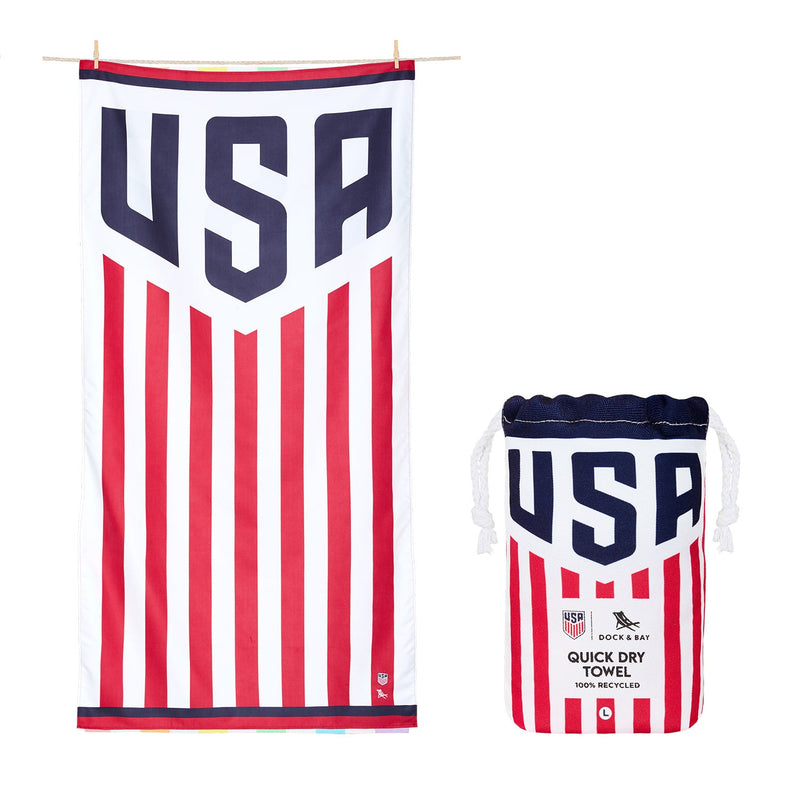
Where to buy Dock&Bay
Still selling as of 3 February 2026. Check today's price and availability.
Affiliate link — we may earn a commission at no extra cost to you.
See the full Dock&Bay deal breakdown and term sheet →
More from Home & Lifestyle
 Deal
DealLe Beanock
A beanbag hammock
 Deal
DealElizabeth Galton Ltd
Custom-made jewellery
 Deal
DealSnowbone
Handle attachment for snowboards
 Deal
DealSquare Mile
Wireless broadband supplier to UK marinas